A general ASTRONOMY site to get you started exploring the night sky
Optimized for desktops and laptops.
Most pages on phones and tablets will overlap.
For information on celestial events like ECLIPSES or COMETS,
I recommend Space.com or SpaceWeather.com
PARADE OF PLANETS • October 2026
LATE “NIGHT”
Mars rises in the east around 1 AM in the fainter constellation Cancer. This is not the best time to view Mars through a telescope because it is fairly far away from Earth and thus appears small—difficult to see any detail. Yes, it is reddish in color and does not twinkle which makes it easier to identify. Mars gets close to Earth every 26 months and at these times it will appear large enough in telescopes to see its various features. The next time this will occur is February 2027.Jupiter rises about 45 minutes after Mars—trailing the God of War. Jupiter is always a favorite in a telescope, even a small one because the four Galilean moons are always visible as well as the two equatorial and parallel bands on its cloud “surface.” The Great Red Spot is not easy to recognize anymore because its color is pale and blends in with its surroundings. As a “star,” Jupiter is always brighter than any other star except for Venus.
TRANSITIONING
Venus is transitioning from an evening star to a morning star and will be very visible in the early morning eastern sky mid-November.
EVENING
Saturn, in Pisces, rises in the east as the Sun is setting in the west. This is called Opposition (opposite the Sun). At opposition, Saturn is the brightest it gets in the sky, appears the largest in telescopes and stays “up” all night long.
Remember • Twinkle Factor
The planets DO NOT normally twinkle like stars unless they are very close to the horizon or the atmosphere is extremely turbulent. So, even thought Saturn is not very bright, it is easier to identify because it does not twinkle. And, Mars is the same but every 26 months, it gets very bright and can't be missed. Mars also has a red tint to it.
SKY
WATCH
There should be a naked eye NOVA star showing for a few days in the night sky sometime during the next year. Click here for more information.
Header Image
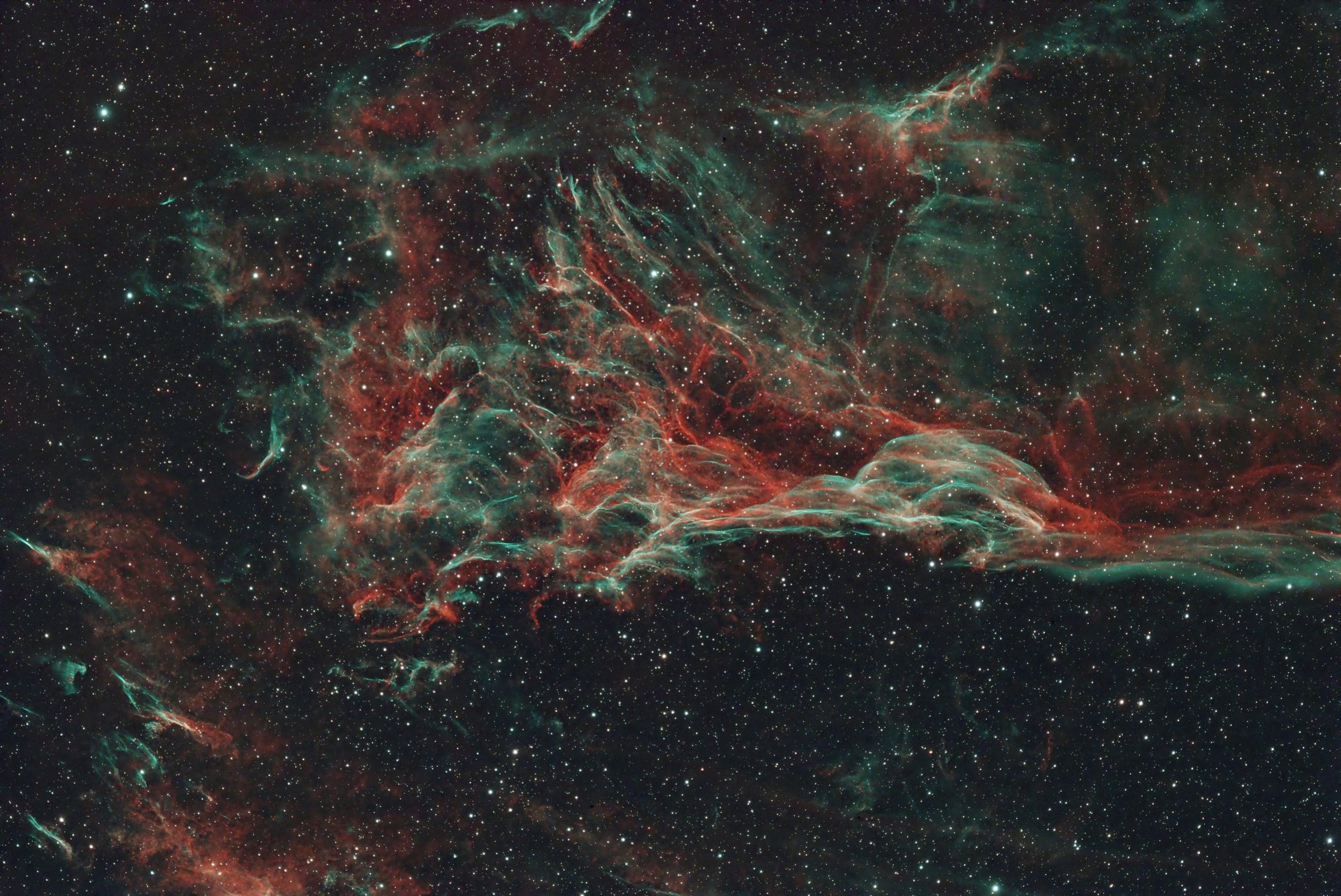
The celestial image used for this site's header is part of the Veil Nebula, a supernova remnant in the constellation Cygnus (the Swan) visible throughout most of the summer and fall. This triangular wedge is a fainter part somewhat between the two major sections that make up the Veil Nebula and it is called Pickering’sTriangle. I took this image using a 6-inch diameter refractor telescope.